Dual Loop Vehicle Sensor for Parking Barrier Gate with High
Sensitivity Truck Detection
JUTAI dual-loop vehicle sensor is engineered for parking barrier
gate systems, providing high-precision vehicle detection for cars,
vans, and large trucks. With two independent detection channels, it
ensures reliable vehicle presence sensing for automatic gate
control, traffic management, and secure access systems.

Common Applications of Inductive Loop Sensors
- Parking Management
- Toll Booths & Highways
- Gated Communities & Residential Areas
- Commercial Buildings & Offices
- Airports & Transport Hubs
- Industrial & Warehouse Facilities
- Event & Stadium Parking
- Smart City Traffic Systems
- Fleet & Logistics Centers
- Bus & Transit Terminals
Key Features
Dual-Channel Detection
Independent vehicle sensing (CH1 & CH2)
High Sensitivity
Detects trucks, buses, and heavy vehicles
Adjustable Sensitivity & Frequency
Optimized for different loop setups
Relay Output
Directly controls barrier gates & access systems
LED Status Indicators
Power, detection, and loop status
Easy Loop Installation
Works with road-embedded inductive loops
Technical Specifications
| Feature | Details |
|---|
| Power Supply | 100-240V AC (LD-200) / 12-24V DC (LD-202) |
| Detection Method | Inductive Loop (地感) |
| Channels | 2 (CH1 & CH2) |
| Output | Relay (NO/COM) |
| Vehicle Types | Cars, Trucks, Trailers |
| Sensitivity | 8-Level Adjustment (0.015%-0.8%) |
| Frequency | 20KHz-100KHz (Adjustable) |
| LED Indicators | Power (Red), Detection (Green) |
| Loop Wires | CH1 (Pin 3,4), CH2 (Pin 5,6) |
| Relay Contacts | CH1 (Pin 10,11), CH2 (Pin 7,8) |
Why Choose JUTAI Sensor?
- Best for Parking Barriers - Ensures no false triggers
- Truck & Heavy Vehicle Compatible - No missed detections
- Customizable Sensitivity - Works in different road conditions
- Durable & Weatherproof - Suitable for outdoor installations
Connections

Indicators and Switches
- Power LED (RED): Illuminates to indicate "Power ON."
- CH1 Detection LED:
- Steady On: Indicates vehicle detection
- Slow Blinking: Indicates a loop short circuit or insufficient
twists after the loop
- Fast Blinking: Indicates a loop open circuit or excessive twists
after the loop
- CH2 Detection LED:
- Steady On: Indicates vehicle detection
- Slow Blinking: Indicates a loop short circuit or insufficient
twists after the loop
- Fast Blinking: Indicates a loop open circuit or excessive twists
after the loop
Sensitivity Selection
Sensitivity and frequency adjustment is facilitated through a 7-way
dip switch and 10-way dip switch settings. Users can choose from 8
different sensitivity settings by configuring the dip switch
positions according to the provided tables.
- Dip switches 6, 7, and 8 govern CH1 sensitivity, ranging from 0.8
(least sensitive) to 0.015 (most sensitive)
- Dip switches 3, 4, and 5 control CH2 sensitivity, ranging from 0.8
(least sensitive) to 0.015 (most sensitive)

Switch 1 (S1): Channel 1 Loop Function Selection
Special Sensitivity Increase For Both Trailer (Both Channels)

Special Functions Setting (Direction Detection Modes)

CH1 and CH2 Sensitivity Selection

Frequency Settings (20 K to 100 KHz)

Reset Button: Please note: The LD-200 must be reset every time a setting change
is made to the Dip switches.
Installation Precautions and Troubleshooting
- Coil Cutting Size and Embedding Guidelines are as shown in the
diagram on the right
- It is recommended to use ferromagnetic wires for the induction
coil, with a total length of up to 500 meters
- The cutting size of the coil should be a rectangle with a length of
1.0 to 2.0 meters and a width of 0.8 to 1.2 meters, avoiding right
angles at corners as much as possible
Recommended Installation Overview
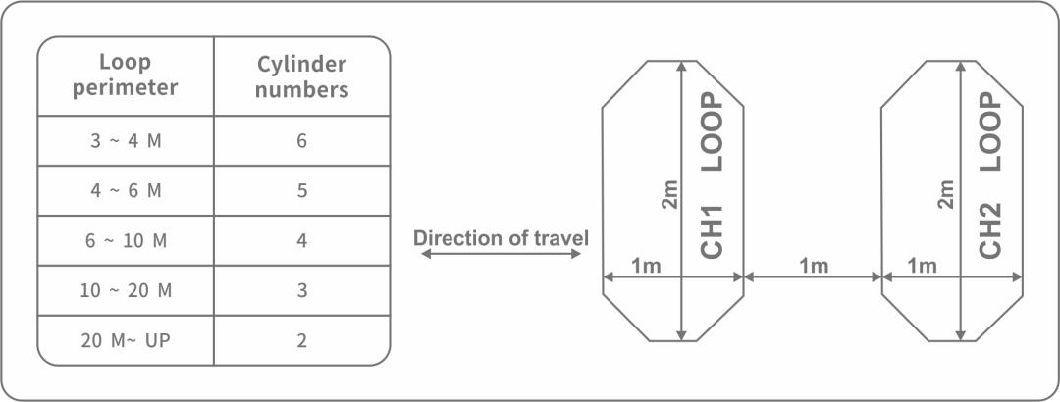
When installing, please keep the product plug and socket in the
vertical direction

Application
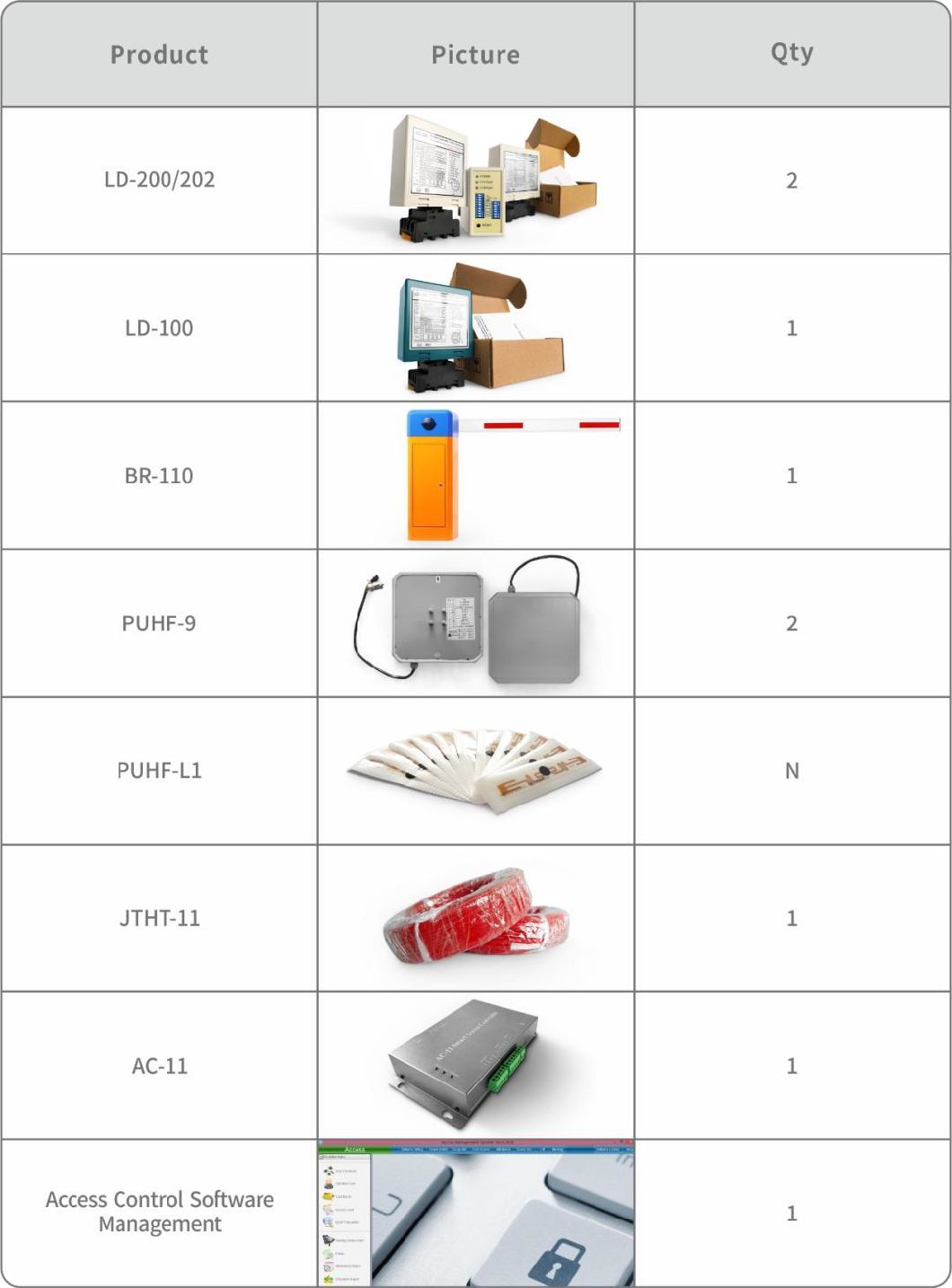
The JUTAI LD200/202 double-channel vehicle loop detector series,
equipped with direction recognition function, is ideal for numerous
single-channel entry and exit scenarios. When integrated with the
JUTAI One door controller (Model: AC-11), JUTAI gate barrier
(Model: BR-110), and JUTAI long-range RFID reader (Model: PUHF-9),
along with high-temperature resistance loop coils (Model: JTHT-11),
it forms a seamless solution for single-channel entry/exit access
control systems.
Working Principle
Entry Process:- When a car enters the community or parking lot, the two loop coils
are pressed simultaneously
- The JUTAI Double Channel Loop Detector (LD-200/202) triggers the
UHF reader located at the entrance
- The UHF reader reads the card ID and sends it to the controller
(AC-11) via Wiegand output
- The controller verifies the ID's validity and outputs a relay
signal to open the gate barrier
- The car enters the community or parking lot, and as it passes the
barrier gate, the barrier arm lowers automatically
- The JUTAI Single Channel Loop Detector (LD-100/102) ensures safety
and anti-smashing functionality during this process
Exit Process:- When a car exits the community or parking lot, it passes by an
inside UHF reader
- The LD-200/LD-202 triggers the UHF reader, which reads the card and
sends the ID to the controller
- The controller verifies the ID's validity and outputs a relay
signal to open the gate barrier for the car to exit
- As the car passes through the barrier gate, the barrier arm lowers
automatically
- The LD-100/102 provides safety and anti-smashing functionality
during this process
Direction Recognition:- The Direction Recognition Function of LD-200/LD-202 ensures that
the double channels loop detector does not trigger the signal again
when the car passes another UHF reader, thereby recording only the
entry or exit records in the system

The JUTAI LD-200/202 Double Channel Loop Detector can also function
as two independent single-channel loop detectors. This
configuration is suitable for standard one-in and one-out parking
lots, where there is one barrier and one long-range reader at both
the entrance and exit.
In this setup, one loop coil is used to trigger the reader and read
the card, while the other loop coil is dedicated to the barrier's
anti-smashing function. By utilizing the LD-200/202 as two
independent loop detectors, there is a potential cost-saving
benefit from an economic standpoint. This setup reduces some of the
hardware costs associated with using separate detectors for each
function.
This functionality is achieved by enabling the Independent Working
Mode feature of the LD-200/202, allowing it to operate effectively
in this dual capacity.


 Gate Loop Detector for Barrier Industrial Doors Loop Short Open Circuit Indicator Reliable Performance

